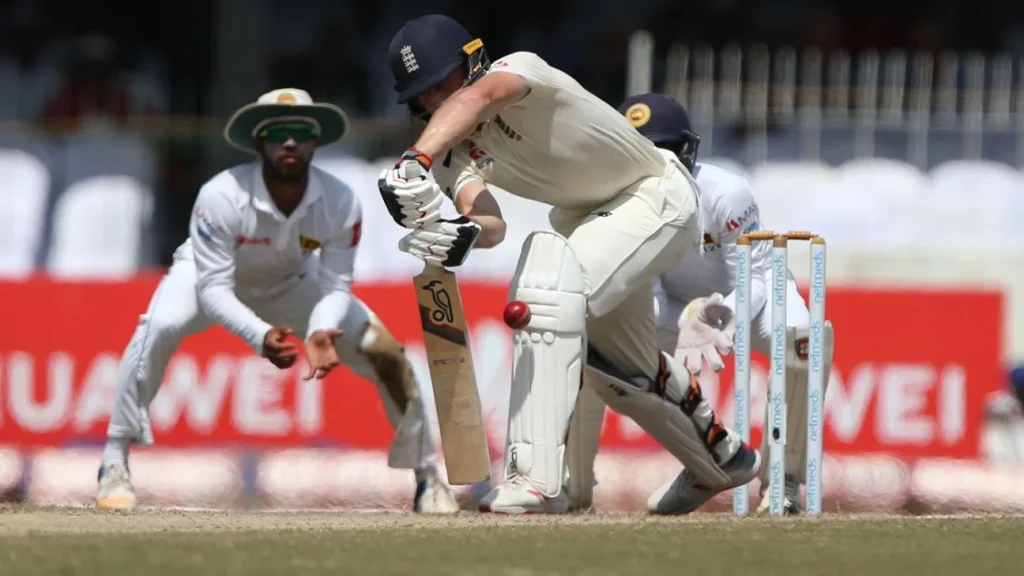

LBW, or Leg Before Wicket, is one of the most important dismissal rules in cricket. It allows the umpire to give a batter out when the ball hits the batter’s body instead of the stumps, provided specific conditions are met.
However, a ball hitting the batter’s leg does not automatically mean an LBW dismissal. The umpire must consider whether the delivery was a no-ball, where the ball first lands (if applicable), whether it touched the bat before the batter’s body, where it struck the batter, and whether it would have hit the stumps.
According to Law 36 of the Laws of Cricket, all five conditions must be satisfied for a batter to be dismissed LBW. The MCC’s fourth edition of the 2017 Code took effect on 1 October 2026 and retains the five essential LBW conditions while updating terminology and other wording.
What Is LBW in Cricket?
LBW stands for Leg Before Wicket. It is a method of dismissal covered by Law 36 of the Laws of Cricket.
A batter can be given out LBW when a delivery that is not a no-ball hits the batter’s body before touching the bat, and the ball would have hit the stumps if the batter had not intercepted it. The decision also depends on where the ball first lands, when applicable, and where it strikes the batter.
Despite its name, LBW does not apply only when the ball hits the leg. The ball can strike the batter’s pad, thigh, torso, or another part of the body. The umpire must then assess the other requirements of the law.
The purpose of this rule is to prevent batters from using their bodies to stop deliveries that would otherwise hit the wicket.
LBW Rules in Cricket: All 5 Conditions Explained
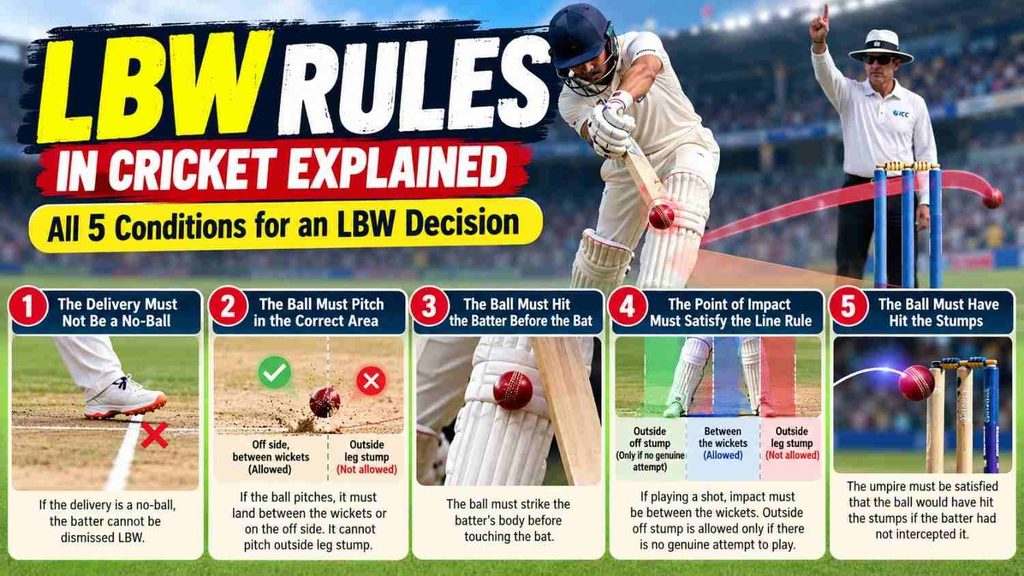
Under Law 36, a batter can be dismissed LBW only when all five required conditions are satisfied.
1. The Delivery Must Not Be a No-Ball
The first condition is that the bowler must deliver a ball that is not called a no-ball. If the delivery is a no-ball, the batter cannot be dismissed LBW from that delivery.
For example, a bowler oversteps the crease and delivers a ball that hits the batter’s pad directly in front of the stumps. Even if the ball would have hit the wicket, the batter cannot be given out LBW because the delivery was a no-ball.
A no-ball can still lead to other forms of dismissal permitted by the Laws of Cricket, but LBW is not one of them.
2. The Ball Must First Land in the Correct Area, If Applicable
The second condition concerns where the ball first lands before reaching the batter.
Under the 2026 edition of the MCC Laws, if the ball is not intercepted before landing, it must first land between the wickets or on the off side of the striker’s wicket. If it first lands outside the line of leg stump, the batter cannot be given out LBW.
For example, a right-arm bowler delivers a ball that first lands outside the batter’s leg stump and then turns into the pads. Even if the ball would have hit the stumps, the batter is not out LBW because the ball first landed outside leg stump.
However, a delivery that first lands outside off stump can still result in an LBW dismissal. The ball does not have to land directly in line with the stumps.
Important exception: If the ball reaches the batter without landing, the landing-location requirement does not apply. This is known as a full-pitch interception. The remaining LBW conditions must still be satisfied.
The 2026 edition uses the wording “lands” and “first lands” in place of the previous “pitches” terminology in this context. This is a wording clarification; the five essential LBW conditions remain in place.
3. The Ball Must Hit the Batter Before the Bat
The third condition is that the ball must not have touched the bat before it intercepts the batter’s body.
The ball can hit the batter before landing or after landing. Either is possible under the LBW law.
If the ball touches the bat first and then hits the pad, the batter cannot be given out LBW. The same principle applies when the ball touches the bat and the batter’s body simultaneously: the umpire must be satisfied that the ball intercepted the batter’s person before touching the bat.
Consider two examples:
Example one: A fast bowler delivers a straight ball. It hits the batter’s pad before touching the bat, and the other LBW conditions are satisfied. The batter can be given out.
Example two: A batter attempts a defensive shot. The ball brushes the bat before striking the pad and would otherwise have hit the stumps. The batter is not out LBW because the ball touched the bat first.
Key rule: Under Law 36.2, only the first interception is considered when assessing the relevant contact and impact conditions. A later contact with the bat or body does not replace the first interception for this assessment.
4. The Point of Impact Must Satisfy the Line Rule
The fourth condition concerns where the ball first strikes the batter’s body.
If the batter makes a genuine attempt to play the ball with the bat, the point of impact must be between the line of the two wickets. A batter struck outside the line of off stump while genuinely attempting a shot is not out LBW.
There is an important exception. If the batter makes no genuine attempt to play the ball with the bat, impact outside the line of off stump can still result in an LBW dismissal, provided the other conditions are satisfied.
For example, a batter leaves a delivery without attempting a shot. The ball strikes the pad outside off stump and would have hit the wicket. If the delivery and landing requirements are also satisfied, the batter can be given out LBW.
This exception often causes confusion among spectators. The key question is not simply whether the batter played a shot. The umpire must judge whether the batter made a genuine attempt to play the ball with the bat.
Impact outside the line of leg stump does not qualify for an LBW dismissal, even if the ball would otherwise have hit the stumps.
Important clarification: The point of impact can qualify for LBW even when it is above the level of the bails. A high impact does not automatically make the batter not out.
5. The Ball Must Have Hit the Stumps
The fifth condition is the final test. The umpire must be satisfied that the ball would have hit the wicket if the batter had not intercepted it.
A ball can hit the batter’s pad directly in front of the stumps and still result in a not-out decision if it would have passed over the stumps or missed them on either side.
For example, a spinner bowls a delivery that turns sharply and strikes the batter’s front pad. The ball first lands in the correct area and hits the pad before the bat. However, the projected path shows that the ball would have missed leg stump. The batter is not out LBW.
This is where ball-tracking technology can help the third umpire during a Decision Review System (DRS) review. It estimates the ball’s path and shows whether the delivery would have hit the wicket.
Under Law 36, the umpire assesses the ball’s projected path as though its path before interception had continued after interception, regardless of whether it might have landed again.
All five conditions must be satisfied together. If even one required condition fails, the batter cannot be dismissed LBW.
LBW Rules at a Glance
| Condition | What the umpire checks | When the batter is not out |
| Legal delivery | The delivery is not a no-ball | The delivery is a no-ball |
| Landing location | If the ball lands before interception, it first lands between the wickets or on the off side | The ball first lands outside leg stump |
| First contact | The ball intercepts the batter before touching the bat | The bat touches the ball first, or the required first interception condition is not met |
| Point of impact | Impact satisfies the line rule | Impact is outside the permitted area |
| Projected path | The ball would hit the stumps | The ball would miss the stumps |
How Does DRS Work for an LBW Decision?
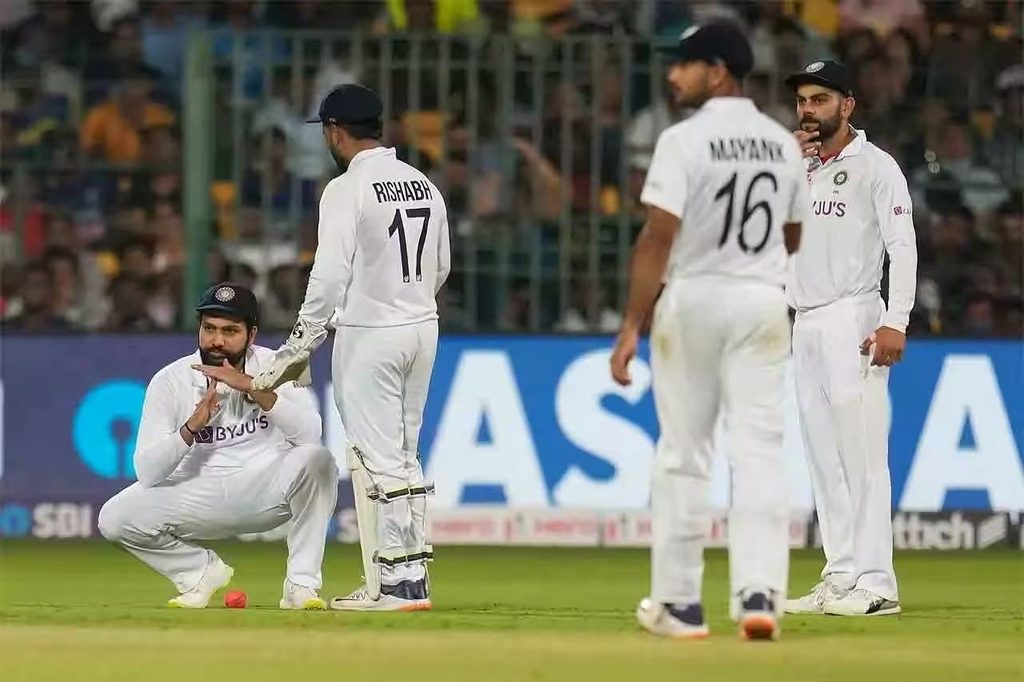
The Decision Review System, commonly called DRS, allows teams to challenge certain on-field decisions under the applicable competition rules.
When an LBW decision is reviewed, the third umpire checks the relevant evidence. Ball tracking generally presents three key elements:
- Pitching: Where the ball first landed on the pitch, when applicable. This term is commonly used in DRS displays, although the 2026 MCC Laws use “lands” in the relevant law.
- Impact: Where the ball first struck the batter.
- Wicket: Whether the projected path would hit the stumps.
The third umpire also checks whether the delivery was a no-ball and whether the ball touched the bat before the batter’s body, using the available evidence and the applicable playing conditions.
The DRS process follows the relevant competition’s playing conditions.
What Does Umpire’s Call Mean in LBW?
Umpire’s Call is a marginal result in the Decision Review System (DRS). It recognises the limits of ball-tracking technology and preserves the original on-field decision in specific circumstances.
Under the applicable ICC playing conditions, Umpire’s Call can apply to the Pitching, Impact or Wicket element of an LBW review. The criteria differ between these elements, so the same 50% threshold should not be applied to all three.
How Does the 50% Rule Work in LBW?
For the Wicket element, ball-tracking assesses whether the ball would have hit the wicket and where its projected path falls relative to the defined Wicket Zone.
The 50% figure is commonly used to explain the marginal boundary in the Wicket assessment. In simple terms, at least half of the ball must overlap the relevant wicket area for the projected path to meet the applicable hitting threshold. The precise classification follows the relevant competition’s DRS playing conditions.
Ball tracking classifies the projected path as one of three outcomes:
- Hitting: The ball meets the applicable criteria for hitting the wicket.
- Umpire’s Call: The ball is projected to hit the wicket, but the result falls within the defined marginal area.
- Missing: The projected path shows that the ball would miss the wicket.
If an on-field not-out decision is reviewed and the Wicket result is Umpire’s Call, the batter remains not out. If the original decision was out and the relevant result is Umpire’s Call, the batter remains out, subject to the other applicable review requirements.
Why Does the Height of the Bails Matter?
The ICC changed the DRS Wicket Zone so that it accounts for the height of the bails, extending the relevant height boundary to the top of the bails rather than stopping at their bottom edge.
The wicket zone is defined by the outline of the stumps and bails under the applicable playing conditions. This affects how ball tracking classifies deliveries that narrowly clip the wicket.
For example, if the projected path shows the ball clipping the upper edge of the bails, the classification depends on how much of the ball overlaps the defined Wicket Zone and whether the relevant threshold is met.
The change does not mean that every ball clipping the bails automatically overturns an on-field decision. The result depends on the ball-tracking classification and the applicable DRS playing conditions.
Umpire’s Call is not an automatic decision for every close LBW appeal. Its effect depends on the original on-field decision, the element under review and the applicable playing conditions.
Common LBW Misconceptions
Several common misunderstandings make LBW decisions seem more complicated than they are.
Myth 1: The Ball Must Hit the Leg
False. The ball can hit another part of the batter’s body. The remaining conditions must still be satisfied.
Myth 2: Every Ball That Hits the Pads in Front of the Stumps Is Out
False. The umpire must consider the delivery, landing location where applicable, first contact, impact and projected path.
Myth 3: A Ball Landing Outside Off Stump Can Never Result in LBW
False. A ball that first lands outside off stump can lead to an LBW dismissal if the other conditions are met.
Myth 4: A Batter Is Always Safe When Struck Outside Off Stump
False. If the batter makes no genuine attempt to play the ball with the bat, impact outside off stump can still qualify.
Myth 5: DRS Always Overturns a Close Decision
False. The technology provides evidence, but the review outcome depends on the applicable rules, the original decision and the findings from ball tracking. Umpire’s Call can preserve the on-field decision.
Myth 6: Impact Above the Bails Automatically Means Not Out
False. Under Law 36.1.4, the point of impact can qualify even if it is above the level of the bails. The other LBW conditions must still be satisfied, including whether the ball would have hit the wicket.
Conclusion
LBW rules in cricket become easier to understand when you remember the five required conditions: a legal delivery, the correct landing area where applicable, contact with the batter before the bat, a qualifying point of impact, and a projected path that would hit the stumps.
The most important lesson is that a ball hitting the pads does not automatically mean the batter is out. The umpire must assess every relevant condition under Law 36 before making the decision. Only the first interception is considered when applying the relevant contact and impact requirements; the projected-path condition assesses whether the ball would have hit the wicket.
Understanding these rules, including the 2026 terminology, the wicket zone and Umpire’s Call, will help you follow LBW appeals, interpret DRS reviews and enjoy cricket with a clearer understanding of the Laws of Cricket.
Frequently Asked Questions About LBW Rules
LBW stands for Leg Before Wicket. It is a method of dismissal under Law 36, where a batter can be given out if the ball intercepts their body before the bat and would otherwise have hit the stumps, subject to the other required conditions.
Yes. A ball that first lands outside off stump can result in an LBW dismissal. The batter may be out if the ball strikes the body before the bat, the impact meets the required line conditions, and the ball would have hit the stumps.
No. If the ball touches the bat before striking the batter’s body, the batter cannot be dismissed LBW from that delivery.
No. Impact outside the line of leg stump does not qualify for an LBW dismissal, even if the ball would otherwise have hit the stumps.
No. A batter cannot be dismissed LBW from a delivery called a no-ball. Other dismissal methods may still be possible under the applicable Laws of Cricket.