


The Indian Premier League (IPL) is one of the most competitive T20 cricket tournaments in the world. Every season, ten franchises compete for the championship, but only four teams advance to the playoffs.
The four qualifying teams are the franchises that finish in the top four positions in the league-stage points table. The top two teams receive an additional opportunity to reach the final, while the third and fourth-placed teams must win their knockout matches to remain in contention for the title.
The IPL playoff format rewards consistency throughout the league stage. Understanding the qualification rules, points system, Net Run Rate (NRR) and playoff tie-breakers helps fans follow the competition and understand how teams reach the final.
How Many Teams Qualify for Playoffs in IPL?
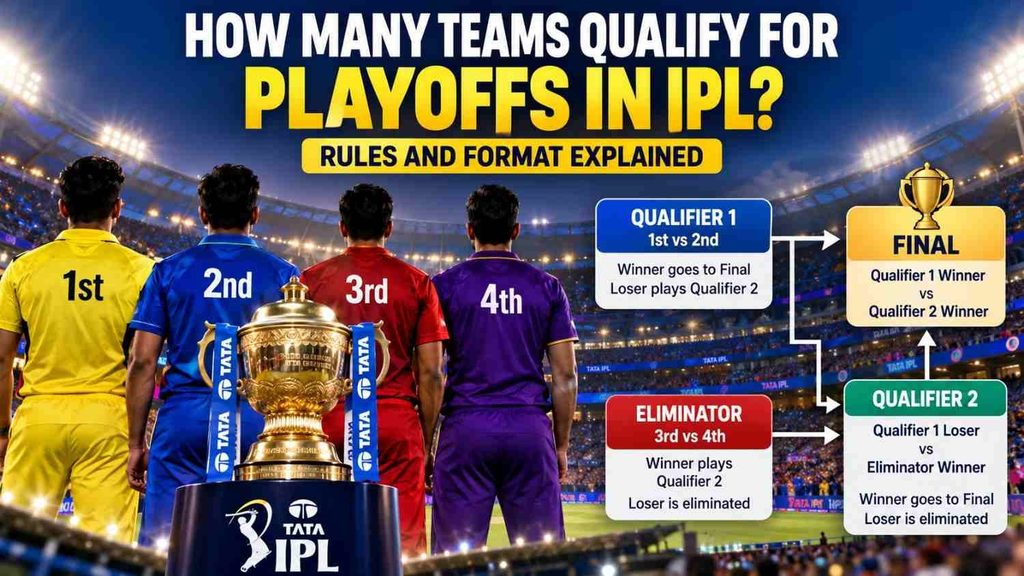
Four teams qualify for the IPL playoffs. They are determined by their final positions in the league-stage points table.
Under the standard IPL format, ten teams compete in the tournament, and each team plays 14 league matches. Teams earn points based on their results, and the four highest-ranked teams advance to the playoffs.
Here is a quick overview of the IPL qualification rules.
| IPL Format Detail | Information |
| Total teams | 10 |
| League matches per team | 14 |
| Total league-stage matches | 70 |
| Points for a win | 2 |
| Points for a loss | 0 |
| Points for a no-result match | 1 per team |
| Teams qualifying for playoffs | 4 |
| Total playoff matches | 4 |
| Finalists | 2 |
The four qualifying teams are ranked from first to fourth. The top two teams play Qualifier 1, while the third and fourth-placed teams compete in the Eliminator.
The winner of Qualifier 1 advances directly to the final. The losing team receives another opportunity to qualify by playing Qualifier 2 against the winner of the Eliminator.
The winner of Qualifier 2 joins the Qualifier 1 winner in the final to compete for the IPL championship.
Why Does Each IPL Team Play 14 League Matches?
The IPL has ten teams, but each team does not play every other team twice in a traditional home-and-away double round-robin format. That arrangement would require each team to play 18 league matches.
Instead, the IPL uses a two-group scheduling structure, with five teams in each group. Teams play their group opponents twice and follow the prescribed schedule for matches against teams in the other group. The league-stage standings are maintained in a single combined points table.
This arrangement allows every franchise to play 14 league matches while keeping the league stage to 70 matches in total.
After all league matches are completed, the top four teams in the combined points table qualify for the playoffs.
How Does the IPL Playoff Format Work?

Source Image: SportingNews
The IPL uses a four-match playoff format consisting of Qualifier 1, the Eliminator, Qualifier 2 and the Final. This structure gives the teams finishing in the top two positions an important advantage.
1. Qualifier 1
Qualifier 1 features the teams that finish first and second in the league-stage points table.
The winner advances directly to the final. The losing team receives another opportunity to qualify by playing Qualifier 2.
This advantage makes finishing in the top two a major objective for every franchise. Even if a team loses Qualifier 1, it still has a chance to compete for the championship.
2. Eliminator
The third and fourth-placed teams face each other in the Eliminator.
The winner advances to Qualifier 2, while the losing team is eliminated from the tournament. There is no second chance for the team that loses this match.
As a result, teams finishing third and fourth must win their Eliminator and then Qualifier 2 to reach the final.
3. Qualifier 2
Qualifier 2 brings together the loser of Qualifier 1 and the winner of the Eliminator.
The winner advances to the final, while the losing team ends its IPL campaign.
The loser of Qualifier 1 therefore receives another opportunity to reach the final, unlike the team that loses the Eliminator.
4. IPL Final
The final features the winners of Qualifier 1 and Qualifier 2.
Both teams compete for the IPL trophy, and the winner becomes that season’s champion.
IPL Playoff Format at a Glance
| Match | Teams Involved | Result |
| Qualifier 1 | First vs second | Winner advances to the final |
| Eliminator | Third vs fourth | Loser is eliminated |
| Qualifier 2 | Qualifier 1 loser vs Eliminator winner | Winner advances to the final |
| Final | Qualifier 1 winner vs Qualifier 2 winner | Winner becomes champion |
The current four-team Qualifier and Eliminator structure was introduced in 2011. It replaced the earlier straight semi-final format and gives the top two teams a second opportunity to reach the final.
The system creates two possible routes to the final. Finishing in the top two provides a second chance, while teams in third and fourth place must win two consecutive playoff matches to reach the final.
How Many Points Are Needed to Qualify for IPL Playoffs?
There is no fixed points total that guarantees qualification in every IPL season. A team’s chances depend on its match results, the performance of competing franchises and the final league standings.
Under the standard IPL league format, teams receive two points for a win and zero points for a loss. A team generally receives one point when a match ends without a result. The playing conditions also specify how points are awarded for tied matches when a Super Over or subsequent Super Overs cannot produce a winner.
A team playing all 14 league matches can collect a maximum of 28 points by winning every match.
In many seasons, approximately 16 points has been a useful qualification benchmark. However, this is a general guide rather than a guaranteed qualification threshold. Depending on the competition, teams can qualify with fewer points or miss out despite collecting a competitive total.
For example, a team with eight wins from 14 matches earns 16 points if its other six matches are losses. Whether that total is enough depends on the other teams’ results and the official tie-breaking rules.
Winning matches consistently is the best way to secure qualification without relying on other results.
What Is Net Run Rate in IPL Playoff Qualification?
Net Run Rate (NRR) is an important factor in determining team positions when two or more franchises finish with the same number of points and the same number of wins.
It measures the difference between a team’s average runs scored per over and its average runs conceded per over during the league stage.
Net Run Rate = Average runs scored per over − Average runs conceded per over
For example, if a team scores at an average rate of 9.00 runs per over and concedes at 8.20 runs per over, its NRR is +0.80.
A positive NRR indicates that a team has scored at a higher rate than its opponents have scored against it across the relevant matches. A negative NRR indicates the opposite.
How Is NRR Calculated in IPL?
The NRR calculation follows specific rules under the official IPL playing conditions.
- Only matches with a result count: Matches without a result are excluded from NRR calculations. Matches in which a result is achieved under the applicable Duckworth-Lewis-Stern (DLS) method are handled according to the official NRR provisions.
- Super Over scores are excluded: Runs scored and balls faced during a Super Over do not form part of the regular innings totals used to calculate a team’s NRR.
- A team bowled out is charged its full quota of overs: If a team is dismissed before using all its allotted overs, its NRR calculation uses the full quota of overs it was entitled to face, rather than the number of overs actually faced.
- Playoff matches do not change league-stage NRR: Playoff results are not included when determining the regular-season league-table positions.
These rules explain why a team being bowled out well before the end of its innings can suffer a substantial NRR disadvantage.
What Is the Tie-Breaker Order in the IPL Points Table?
Net Run Rate is not the first tie-breaker in the IPL points table. Under the official IPL 2026 playing conditions, teams with equal points are ranked using the following order:
- Number of wins: The team with more wins in league matches is placed higher.
- Net Run Rate: If the teams have equal points and wins, the team with the higher NRR is placed higher.
- Wickets taken per fair balls bowled: If the teams remain equal after the NRR comparison, the team with the higher number of wickets taken per fair balls bowled in matches with results is placed higher.
- Drawing lots: If the teams remain equal after the preceding criteria, their positions are determined by drawing lots.
These tie-breakers apply to the regular-season league table. Playoff match results are not included when determining the league-stage standings.
This order is important because a team with a higher NRR does not automatically finish above another team that has the same points but more wins. The number of wins is considered first.
Can a Team Qualify for IPL Playoffs With 14 Points?
Yes, a team can qualify for the IPL playoffs with 14 points, depending on the season’s results and the final points table.
Fourteen points can come from seven wins and seven losses across 14 matches. However, seven wins do not guarantee a place among the top four teams.
A team with 14 points may qualify if enough competing teams finish below it. If other teams finish with the same points total, the number of wins is considered first. Net Run Rate becomes the next tie-breaker if the teams also have equal wins.
Consider the following simplified example.
| Team | Points | Wins | NRR | Illustrative Outcome |
| Team A | 18 | 9 | +0.90 | Strong qualification position |
| Team B | 16 | 8 | +0.55 | Strong qualification position |
| Team C | 14 | 7 | +0.40 | Could qualify |
| Team D | 14 | 7 | +0.10 | Could qualify or miss out |
| Team E | 14 | 7 | -0.20 | Could miss out |
Note: This is an illustrative example, not an actual IPL points table. The outcome depends on every team’s results and the applicable tie-breaking rules.
In this example, Teams C, D and E have the same number of points and wins. Their NRR values would therefore be used to rank them, assuming the other relevant conditions are equal.
The important lesson is that points alone do not always tell the full story. Teams must also consider their number of wins, NRR and the results of their direct competitors.
What Happens if Teams Finish With the Same Points?
When two or more teams finish the league stage with the same number of points, the IPL applies its official ranking and tie-breaking rules.
The team with more wins is ranked higher. If the teams have equal points and wins, the team with the better Net Run Rate receives the higher position.
If the NRR is also equal, the number of wickets taken per fair balls bowled in matches with results is considered. If the teams still cannot be separated, the final position is determined by drawing lots.
For example, suppose two franchises finish with 16 points after winning eight matches each. The team with the higher NRR would finish higher in the points table, provided no other applicable tie-breaker is needed.
This difference can be particularly important when teams are competing for a top-two finish. Both teams may have qualified, but their final positions determine who plays Qualifier 1 and who must compete in the Eliminator.
Teams should therefore focus on winning matches, improving their NRR and maintaining a strong league-stage record.
What Happens if an IPL Playoff Match Is Tied or Washed Out?
The IPL has specific rules for playoff matches that end in a tie or have no result because of rain or other interruptions. The winner is determined according to the official playing conditions.
If an IPL Playoff Match Is Tied
If both teams finish with equal scores, they compete in a Super Over to determine the winner. If the Super Over is tied, further Super Overs are played according to the playing conditions, subject to the applicable exceptional circumstances and time limits.
What Happens if a Playoff Match Has No Result?
If a playoff match has no result, the teams compete in a Super Over, or further Super Overs if necessary, to determine the winner, provided conditions permit.
If conditions do not permit a Super Over, or the required Super Overs cannot be completed within the available time, the team that finished higher in the regular-season league table is declared the winner of the playoff match.
This rule applies to Qualifier 1, the Eliminator, Qualifier 2 and the Final. The decision is based on the teams’ league-stage positions, not their Net Run Rates alone.
Does the IPL Final Have a Reserve Day?
Yes. For IPL 2026, the Final was scheduled for May 31, with June 1 designated as its reserve day.
If the Final could not be completed on the scheduled day, play could continue on the reserve day under the applicable playing conditions.
However, the IPL 2026 schedule did not provide the same reserve-day arrangement for Qualifier 1, the Eliminator and Qualifier 2. If one of these matches could not produce a result within the permitted time, the official playoff rules determined the winner based on the teams’ league-stage positions.
For future seasons, readers should check the official IPL schedule and playing conditions because reserve-day arrangements may change.
Why Is Finishing in the Top Two So Important?
All four qualifying teams have a chance to win the IPL title, but the top two receive a valuable advantage.
The first and second-placed teams play Qualifier 1. The winner moves directly into the final, while the loser gets another chance in Qualifier 2.
By contrast, the third and fourth-placed teams face elimination in their first playoff match. The winner must then win Qualifier 2 to reach the final.
This makes the difference between finishing second and fourth significant. Both teams qualify for the playoffs, but the second-placed team has an additional route to the final.
For franchises, the goal is not simply to enter the top four. Securing a top-two finish can improve their chances of reaching the championship match by providing a second opportunity after a defeat in Qualifier 1.
Conclusion
Four teams qualify for the IPL playoffs from the ten participating franchises. Their positions in the league-stage points table determine their routes to the final, with the top two earning the advantage of playing Qualifier 1.
Points determine the initial standings, while the number of wins and Net Run Rate can become decisive when teams finish level. If teams remain tied, the official IPL rules provide additional tie-breakers.
Although 16 points can be a useful qualification target, no single points total guarantees a playoff place in every season. NRR calculations also follow specific rules, including the treatment of all-out innings and matches without a result.
For every franchise chasing the IPL trophy, the first objective is to finish in the top four. The next is to secure a top-two position and gain the best possible route to the final.
Frequently Asked Questions
Four teams qualify for the IPL playoffs. They are the top four franchises in the points table at the end of the league stage.
The standard IPL format features ten teams. Each team plays 14 league matches before the top four advance to the playoffs.
There is no fixed points total that guarantees qualification every season. Sixteen points can provide a strong position, but qualification depends on other teams’ results and the official tie-breaking rules.
Yes. A team can qualify with 14 points if its final position is among the top four. Its chances depend on the points, number of wins and, where applicable, Net Run Rates of competing teams.
Qualifier 1 is played between the first and second-placed teams. Its winner advances directly to the final, while its loser gets another chance in Qualifier 2. The Eliminator is played between the third and fourth-placed teams, and the losing team is eliminated.